House Sparrow Passer domesticus
Sparrow is apparently derived from the Anglo-Saxon spearwa , with roots from the Icelandic Sporr meaning ‘Flutterer’. This is also the basis for a number of local names inc: Spadger, Sprig, Sprug, Sprong (variously: Roxburgh, Perth, East Lothian) and Spyng (Kirkcudbright). Aka: Craff (Cumberland), Row-Dow or Roo-Doo (Northants), Thatch or Thack Sparrow (Northants, Salop), and Easing Sparrow (Salop: from eaves) and Philip or Phip from its call.
As a once common bird, and one associated with human habitation, it has a bit of folklore with which I can regale (?) you. In Kent, it was believed that if you caught a Sparrow you must not leave it alive, otherwise the parents of the catcher would die. Now, as there strangely appears to be no time limit on this one, it is another sure-fire prediction. Sparrows have also been credited with prophetic powers:
" Look, my dear " said S's wife to him one morning as he lay in bed. "look
at that kite flying round the room! ” He saw nothing, but heard a noise like
a large bird flapping its wings. A few minutes afterwards a sparrow came,
dashed its bill against the window, and flew away again. " Oh! .... " said Mrs. S.
" ..... something is the matter with poor Edward " (her brother ). She had hardly
said the word when a man on horseback rode up and said, when S. opened the
door to him, " Don't frighten poor Mary, but master has just expired ! " The
messenger had only ridden from Somers Town to Compton Street , Soho.
Kelly (1863) in Curiosities of Indo-European Folk-Lore, pp. 104 , 105. says that he had this story from ‘S’ himself who was possessed of the notion that the sparrow that tapped at his window was the soul of his brother-in-law ".
I am not wholly sure what this tells us about the beliefs of earlier folk really, but I did note that the chapter following this one in the book is titled ‘The Psychopomp of Cows and Dogs’. Yes, yes, I had to look that one up. It’s apparently derived from the Greek for the ‘guide of the souls'. In Jungian psychology it is also said to be a mediator between the unconscious and conscious realms. Now that’s a nice circular coincidence, because I think psychology is basically the steaming stuff you find laying on the ground behind male cows. Anyway, in this chapter is a bit on ‘death omens from cows’. As I have a load in the field next door, who look at me oddly sometimes when I go for a walk, I decided not to read that bit. Sometimes ignorance has a lot to commend it. The things you learn here!
Where were we, Oh yes, Sparras, that’s right.
attentive
I’ve wanted a nice typical picture of this species, to start off this quick tour of a few passerines for a while. But House Sparrows are not abundant where I live, so it had to wait.
Then one day, driving slowly past a high garden hedge in a small hamlet alongside Beauly Firth, I heard that distinctive chatter and conversation. Quickly pulling over I looked back to see a dozen or so flying back and forth between their home and an escaped rose bush, just across the road. Handbrake, camera, door, walk slowly back, and over the course of perhaps 15 mins I watched and listened to the activity. For my money (which aint a lot, so don’t get too excited) you can’t beat a group of Sparrows for just plain cheerfulness. I like them a lot.
I then remembered to take a few pictures, for this very page!
Look this is not award winner I am sure, but this picture sums up a House Sparrow perfectly. It exhibits that all that alertness and attentiveness (if that isn’t tautological) that you expect from this species. You can see that he’s paying attention to everything, including his compatriots; taking it all in.
I must try and come back in spring, and catch him in his fresh breeding colours. These aren’t bad, but his spring outfit will be sharper.

Passer domesticus ♀ Charleston
16-10-2025
Canon R5 mk2 EF500mm x1.4 f5.6 1/512th ISO 800
all mine
I like to believe he’s telling his chums that these two are his.

Passer domesticus ♀ Charleston
16-10-2025
Canon R5 mk2 EF500mm x1.4 f5.6 1/512th ISO 500
this lot will keep them quiet
Wandering the grounds of Raigmore Hospital I hear the sweet chattering of sparrows and, yes, also that ‘feed me, feed me, feed me’ bleating of ever-hungry chicks. I look around for the tell-tale back and forth of harassed parents. After a bit I spot mummy flying out from a gap between cladding at the corner of a building. It’s a superb spot for a nest. Nice, dry and protected. Not quite as convenient for the photographer though. The only clear view into the space is from the middle of a service road carrying traffic around the hospital. Why the middle? Well the other side is too far away, and closer hasn’t the angle. Light can be such a bastard with all that travelling in straight lines stuff. So the middle of the road it has to be. Fortunately it is quite quiet. Well, I must have been there half an hour, before I got the shots I wanted, with the odd car and van having to slow and creep past me. I imagine they were wondering what’s this twat doing in the middle of the road with a big lens, mebbe they just wanted to see what I photographing. What they would have thought had they known it was just a sparra.
Here we have a stressed dad bringing back some big juicy black flies. I can hear him thinking, this lot will keep them nice and quiet for a bit. . . .

Passer domesticus ♀ Inverness
19-05-2026
Canon R5ii EF500mm x1.4 f5.6 1/1580th ISO 4000
me want more now, me want . . . . . . .
. . . . . and now he’s undoubtedly thinking something like ‘don't those little bastards ever stop’.

Passer domesticus ♀ Inverness
19-05-2026
Canon R5ii EF500mm x1.4 f5.6 1/1580th ISO3200
joker
the nearest sparrow colony is a few miles down the road, I decided to pop over and see what was happening, and that constant chattering just makes me happy. It’s chick time and parents are busy flying back and forth. I hear a plaintiff ‘feed me’ from just through a sparse hedge to my left. Moving to get an angle I see this little chap. It looks like he’s still in that zombie ‘my brain hasn’t wired up yet’ time when mum or dad just park them somewhere while they fetch grub.
I took his picture because that bright yellow enlarged gape tissue exhibited by chicks of many birds just made him look so sad and dejected. I’m sure food was coming.
Sorry it’s a tad blurry I’m afraid. This is because a few twigs remained in the only line of sight I could get without I felt risking disturbing him, and at his stage of development (?) well I'm sure he'd have been fine but simply why do it?

Passer domesticus ♀ Strathnairn
06-08-2023
Canon R5 RF100-500mm x1.4 f9.3 1/1580th ISO 4000
Chaffinch Fringilla coelebs
Previously known regionally as: Spink, pinkety, pink, pink twink, chink chaffey, chink chink amongst many others for its tedious and monotonous call or, variously, white wing, white finch, pea- pied- abd pine-finch, shilfa, skelly shel or sheld for its plumage and colours. Current common name derives from its appearance in large numbers during threshing and picking over the chaff for grain. Although, largely over-looked perhaps because of the ubiquity they are strikingly colourful and active, giving rise to the proverb 'as gay as a chaffinch'.
I have a kind of pet theory that if chaffies were extremely rare, or a very occasional migrant, 'birdwatchers' would flock to admire them!
Seeing 'real' chaffinches strip seed from wild grasses makes a pleasant change from watching them squabbling and bickering noisily on my garden feeder.
pretty in red
... 'only' a chaffie for sure, but I think he looks rather dapper in his new breeding plumage. The angle here, which conceals the bright wing-bars, and the complementary background colours make this an unusual and 'pretty picture' of this species. Well I get to choose, don't I?
Not exactly a difficult species to capture, pop some seeds out and you've got half a dozen or more, easy, but getting one of them to sit and pose nicely, rather than forming a squabbling mob, not so much.

Fringilla coelebs ♂ Strathnairn
07-04-2024
Canon R5 RF100-500mm (400mm) f9.93 1/664th ISO640
a lady
a lady this time.
An ordinary picture I agree and easy to delete. However, I feel the subtle colours and background are the reasons this one of the fair sex avoided the metaphorical cutting-room floor.
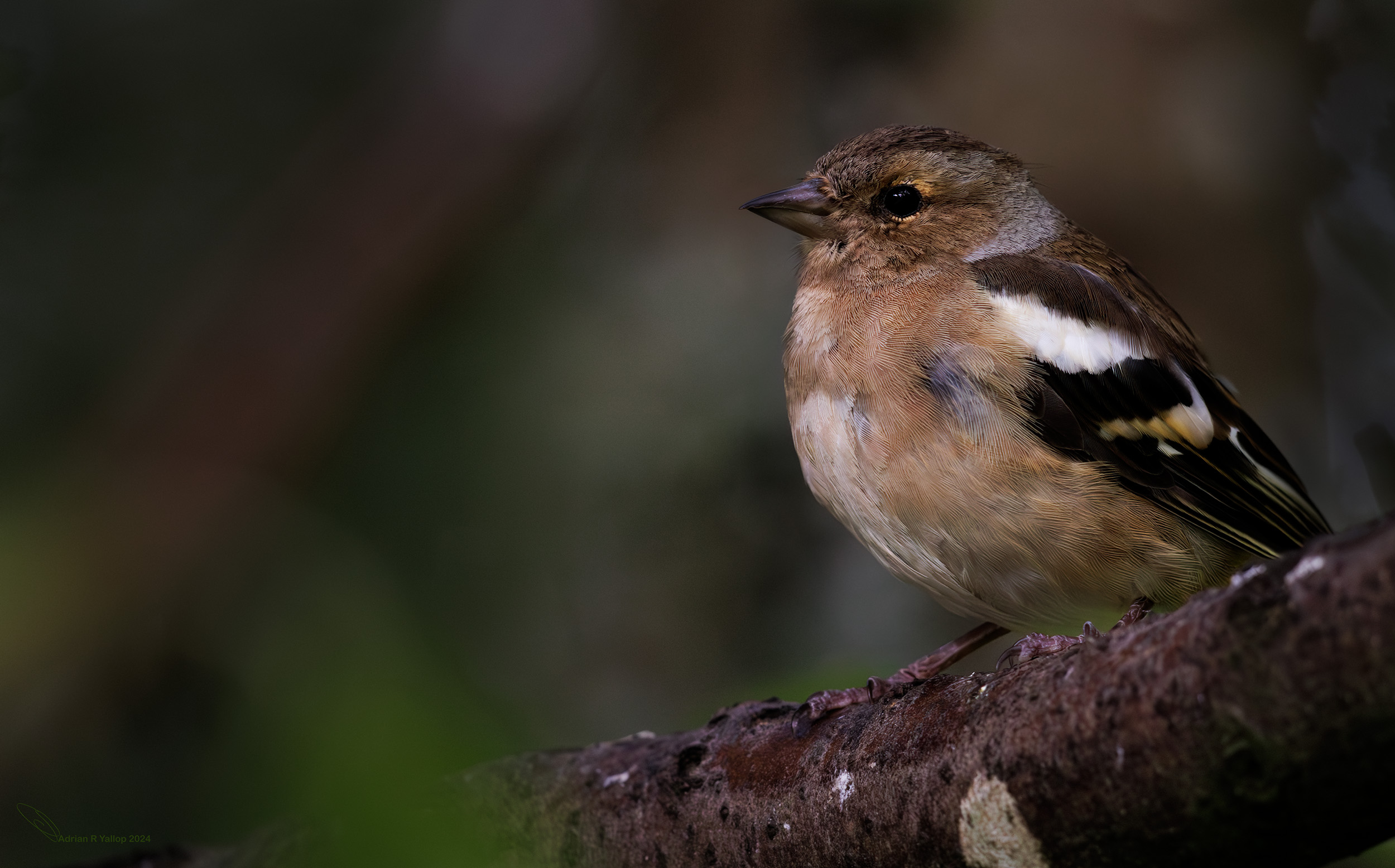
Fringilla coelebs ♀ Strathnairn
04-07-2024
EF500mm f4 (f7.0) 1/1000th ISO 2500
just looking cute
Is it just me, or does it look for all the world like she's standing demurely with her 'hands' held neatly behind her back? Perhaps it is me, but hey it's my website and I decide. She's cute, prim, and modest with it.

Fringilla coelebs ♀ Strathnairn
13-03-2024
Canon R5 RF100-500mm (400mm) f9.93 1/1025th ISO1600
Bullfinch Pyrrhula pyrrhula
Large head and generally compact 'butch' morphology, gives us the current name, as in Bullhead and Bulldog. Earlier names inc: Hoop, Hope (Somerset to Cornwall), Olf (Suffolk), Nope Stafford) Mwope (Dorset), Mawp Lancs) and Pope (Dorset), all derivatives of Alp, used for the bird during the time of John Ray (1627-1705 (one of the English 'pastor naturalists') .
The red of the male gave us Red Hoop (Dorset) and Blood Olp (Norfolk) whereas the brown of the matching parts of the female give Tawny, Tony Hoop and Tonnihood (Somerset). The sleek glossy black head gives rise to Black cap (Lincoln) Billy Black Cap, Black Nob (Salop) together with Monk and Coal Hood.
Non-colouration derived names inc: Plum Bird or Plum Budder, Bud Bird, Bud Finch, Bud Picker for its habit of eating the new buds of tree bushes etc. see illustration below.
Let us not forget that only last century Bullfinches were slaughtered in their thousands (I refuse to use the sanitised 'culled', it was slaughter, plain and simple) to 'protect' orchids. Ironically, MAFF did the same thing to orchids a decade or so later. So now we have no home-grown apples plums etc, and very few Bullfinches. Well done chaps. Lots of sterile arable fields though, lovely.
".... and round perdition's flames.... "
As a photographer some birds just seem especially hard to 'catch', they may be fairly common, you just struggle to get a nice picture for some reason. Often because they are constantly on the 'go'. Another ploy is to always frequent dense vegetation. You see them fly in, you can just make out a shape hopping around in the dark behind thickets of small branches for a minute or so, and then, yup, you see them fly out again. All to repeat the same process in the next bush, and the next.
In the end they can become something of a personal 'white whale'. One of mine that evokes more than any other the famous line of Captain Ahab " Aye, aye! and I'll chase him round Good Hope, and round the Horn, and round the Norway Maelstrom, and round perdition's flames before I give him up", is this particular little bugger.
Anyway, I finally caught one, not that even then he made it easy, oh no, no, no! Walking quietly down a narrow path, with high overhanging scrub on each side, we could actually hear a pair. Suddenly, they flew past, and into a bush some 20m ahead! But, yes, you guessed it, 99% hidden by a thicket of innumerable branches of half a dozen nearer bushes! Right, the sod wasn't getting away this time, there have too many encounters where he has triumphed. So, holding one of Canon's heavy and appropriately named 'big whites', to my eye, trying not to trip over twisted exposed roots, knowing that any moment they could spook and bugger off. I creep forward, bend, creep forward, stand on tip-toe, creep again, twist sideways, trying to line up a clear 'window' though the endless nearer branches. Eventually, my 'white whale' is in my sights! One quick squirt and mebbe I have a reasonable shot or two. I try to do it all again for the love of his life. Sadly, whatever I try, however I bend, she is always obscured with a stick in front of her face! As I move a tad closer they're off. On the way back at the car my left arm starts to spasm involuntarily from the continuous lifting, I clearly need to start doing weights with that arm, wine glasses are apparently not heavy enough to maintain muscle tone, I mean, who'd have thought! Mebbe I could try a bigger glass, and fill it more?
Once home I see that although there was still one final twig directly in line with this beautiful bird, all that dense, out-of-focus vegetation and lichen, give this image a lovely 'dreamy' quality. Bugger it, I'm calling that a draw, the harpoon hit, but bounced off. Till we meet again, Moby Dick.

Pyrrhula pyrrhula ♀ Insh Marshes
23-03-2025
Canon R5 EF500mm f4 1/1025th ISO 1250
Goldfinch Carduelis carduelisa
Goldie, Goldspink, Goolfrench, Redcap, King Harry; Seven-coloured linnet; Speckled Dick, Pround Tailor, Foolscoat, Sherriff's Man and, delightfully, Lady with Twelve Flounces are amongst the numerous regional names given to this bird's colouration. It's like of thistle seed gave rise to Thistle finch and possibly Jack Nicker.
According to George-Louis Leclerc (1707-1788) '...beauty of plumage, melody of song, sagacity and docility of disposition seem all united in this charming little bird.... :. Well, I can't do better than that, so I simply won't try except to add the collective name is a 'charm', how lovely.
" is red-faced finch a better name
?"
A bird so good they named it twice (apologies to Gerard Kenny). A common species around here but, for me anyway, a big of a bugger to capture sitting unobscured and well lit. They're either nervous and flighty, determinedly sitting in shadow, behind a leaf, or usually all three!
I much prefer red-faced finch as a name. The brilliance of that face arises because the colour, like that of many bird feathers, is caused by refraction. To shine like this it needs bright direct sunlight and just at the right-angle, just the stuff it never sits in! This one gave itself up for something like around 25 secs. Next year I might get another picture!

Carduelis carduelis ♂ Strathnairn
2024
Canon R5 Rf 100-500mm 1.4x (700mm) f9.3 1/1025th ISO 250
" did he really come back
?"
well he did promiss to give me more time next year, and he did! Well sure I doubt it is the same one obviously, but he was happy to pose for a few moments. He had also learned the price tho', and demanded a handful of sunflower seeds too.
On a photographic note, this image and the next, show the benefits of using larger aperture lens in creating a much nicer bokeh, the name usually applied to the nature or appearance of the out of focus parts of a photograph. Such lenses are more expansive and heavy but, if you can, just do it. I haven't looked back.

Carduelis carduelis ♂ Strathnairn
09:54 15/05/2025
Canon R5 EF500mm f4 1/2049th ISO 1600
a jewel
Umm, I seem to have pictures of Goldfinch with no 'gold' showing. So this one corrects that, besides he is a very pretty bird and, unusually, a nice clean bill. Perhaps it's actually a lady.

Carduelis carduelis ♂ Strathnairn
09:49 28/10/2025
Canon R5 EF500mm x1.4 f5.6 1/2049th ISO 8000
"red and green should not be seen, except on a pauper or a queen
"
Well I have to disagree with that old victorian adage, especially here, the red standing out from all those spring green leaves.......
this may seem supernumary but I wonder if this is the first pretty picture I've posted of this species - that lovely bokeh and wide pallete of greens providing a nice background to an attentive bird. Pity he hasn't wiped his bill tho' after his last preen. The light was actually a tad too contrasty to avoid burning-out some of the white on his head while retaining the shadow detail here. So. i'll knock a couple of marks off, but sometimes it's just too extreme and, sadly, you cannot tell a wild bird where to stand or how to pose. Well, you can of course, nothing stopping you, it's just they'll not do it, however nicely you ask. I liked his posture and mileu, so he got his picture taken.
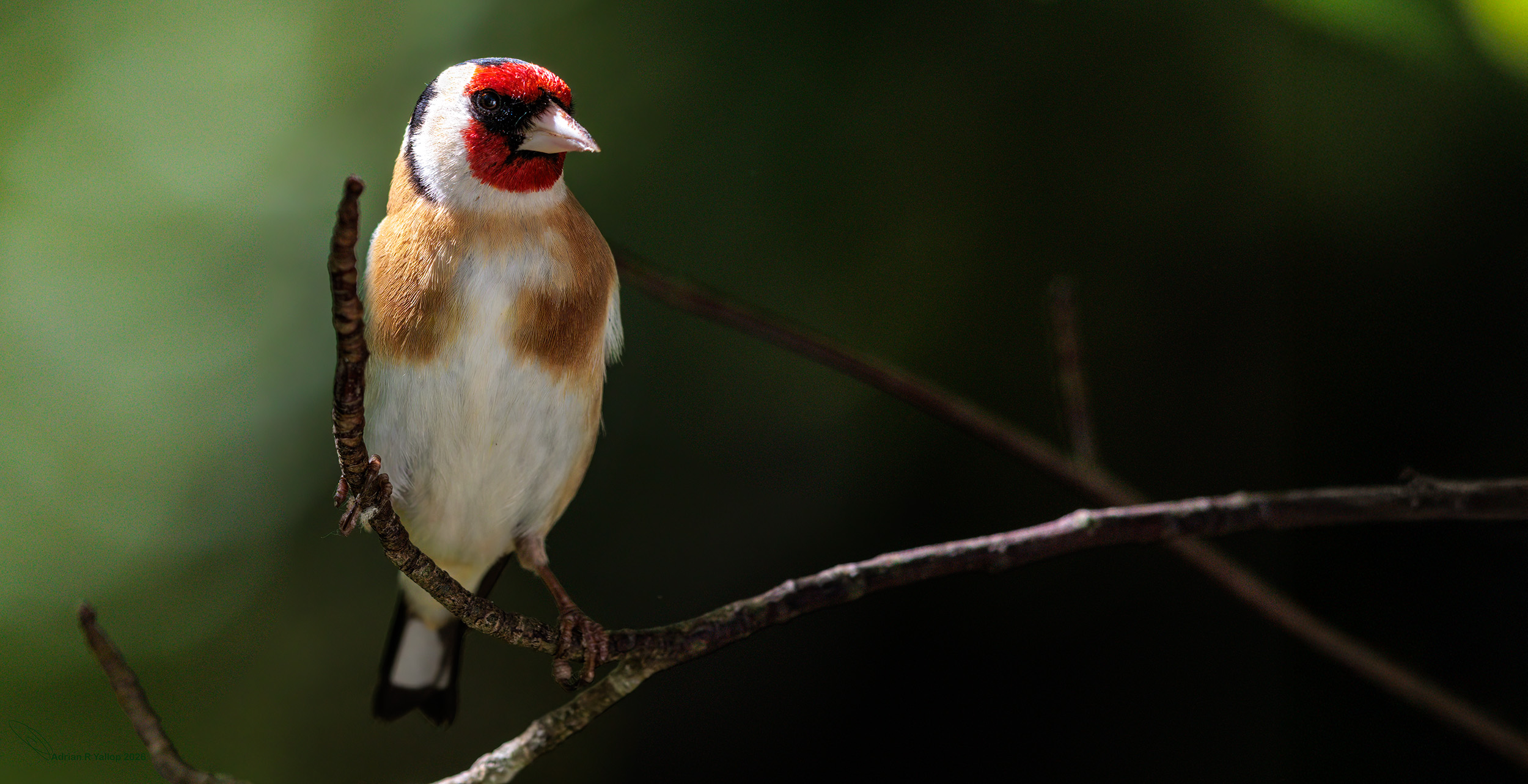
Carduelis carduelis ♂ Strathnairn
09:49 15/05/2025
Canon R5 EF500mm f4 1/2049th ISO 800
Siskin Carduelis spinus
As this species had quite a restricted range in the UK during Victorian and Edwardian times very few regional English names are noted. However, Aberdavine, possibly derived from Alder-finch, and Barley-bird were used, undoubtedly for eating, you guessed it, alder and barley respectively. 'Siskin' probably derives from the Swedish for 'chirper'. In parts of Europe mythology says it can procure a stone that renders its owner invisible, perhaps that why they weren't seen much. I keep looking.
Once limited to the Caledonian forest of Scotland increasing areas of conifer plantation led to rapid population growth and expanding range. Noted as only becoming a visitor to gardens since the 1960s where seed feeders presumably offer easy delights for both bird and watcher. Despite their small size they are feisty little chaps and only cede dominance on a bird feeder to much larger birds, even then not submissively.
canary
?
I have heard them called that by a non-birder, and why not? In bright sun the male plumage equals that of a canary. Well, it's my website and I say so.

Carduelis spinus ♂ Strathnairn
11-04-2024
Canon R5 RF 100-500 1.4x (700mm) f10 1/1000th ISO1600
amongst the buds
?
This little chap said he was happy to pose surrounded by emerging buds. As I thought the colour and light pretty enough, I took a few frames. Only later did he demand sunflower seeds in payment, they learn so quick.

Carduelis spinus ♂ Strathnairn
11-04-2024
Canon R5 RF100-500 1.4x (700mm) f10.0 1/1000th ISO1000
leopard
?
The female brings equal beauty, although it looks a tad like she is wearing a leopard-skin coat here. Despite my feelings about slaughtering animals for their skin I have to admit that sitting nicely in the light as she is, against a darker background, she wears it very well.

Carduelis spinus ♀ Strathnairn
14-04-2023
Canon R5 RF100-500mm (500mm) f7.0 1/1025th ISO 500
lady, with a skill
?
I think this lady looks especially cute because she appears to be uncorking a bottle of wine with her feet. That's my kinda girl!

Carduelis spinus ♀ Strathnairn
11-04-2023
Canon R5 RF100-500mm (500mm) f 7.3 1/1025th ISO400
Greenfinch Chloris chloris
It’s colour also gave rise to numerous local names: Green Linnet (Norfolk, Lancs, and Scotland), Green Bird, Green Olf (Norfolk again, clearly can’t make up their minds), Green Grosbeak, Greeney (Forfar, Cumberland) and Peasweep (perhaps because its call resembles that of a peewit?).
Swainson relates no folklore: so it seems, this species was, rather unusually, neither able to tell the weather or was associated with the Devil’s works in anyway. Must be unique in fact.
big, and bold
?
A great bird, often seen on feeders and bird table, usually through a window. But it is, for all that, shy when it comes to having his photo taken, appear with a camera and, no matter how nicely you ask, it's off to the treetops and bushes. So getting this one, paused for a few moments and just being caught by the bright sun, was a bit of luck.

Chloris chloris ♂ Strathnairn
09:49 15/05/2025
Canon R5 EF500mm f4 1/2049th ISO 800
Crossbill Loxia curvirostra
Given its limited distribution before widespread plantations the only regional English names recorded by Swainson (1885) are Shell-apple and German Parrot, the former for records of the birds splitting apples in half just to get the seeds and leaving the rest. He does note the linking of its crossed bill with the cross of christ in many legends, and reports that peasants in Thuringia often kept the birds owing to a belief they could take-on (i.e effectively cure) disease.
Crossbill
scottish? miles away
Well, I don't want to enter into the controversy about whether the 'Scottish' crossbill really is a separate species, as declared by some people in 1995, or simply a race of Loxia curvirostra. It is a contentious issue, with much squawking and ruffled feathers, that sort of thing (note: at least it had nothing to do with the SNP for a change). Birds, as a group, are very prone to 'splitters', those with a desire identify a separate species whenever they can when, in reality, there may simply be an isolated local population with morphological differences, distinct but certainly not yet speciated. RSPB lists it as separate, whilst the BTO wisely doesn't commit. I sometimes think 'birders' just want another species to tick.
Either way, it's a nice looking bird. However, seeing them in dense forest isn't that easy, as well as giving one a terrible neckache. When they do perch clear on a treetop in line of sight they usually do so miles away, or against a bright sky, or both, just as this lady did. So, it's a rubbish picture, sue me! I intend making it a species to devote more time to next year so hopefully can improve on this poor shot.
Oh, this would be scotica of course, from its location, mebbe she perches on Nessie's head sometimes (another mythical Scottish creature, geddit)

Loxia scotica ♀ Strathnairn
19-03-2024
Canon R5 RF 100-500 1.4x (700mm) f10.0 1/1000th ISO 640
and not a tree in sight
Populations of this species periodically undergo 'irruptions', or dispersals, over significant distances, another reason 'scottish' crossbills don't exist. Now, after you've flown more than 300 km over hostile North Sea waters from Scandinavia, Shetland must seem a most welcome landfall. The next stop in that direction is over 3000km, an unachievable distance for this species. However, it could be considered that, as an eater of conifer seeds, and the almost total absence of any trees on the archipelago, another issue has just started.
Here a little group stranded on a rain and wind-swept cliff-top are stripping the seed from Armeria maritima or sea-pink, all of 3 inches high. Truly a forest bird brought low.
I have no idea how successful this last hope might be but, in reality, these birds are almost certainly doomed. For me, on that day, the feeling of gloom that engendered was emphasised by the dark basaltic grey, the wind and the rain.
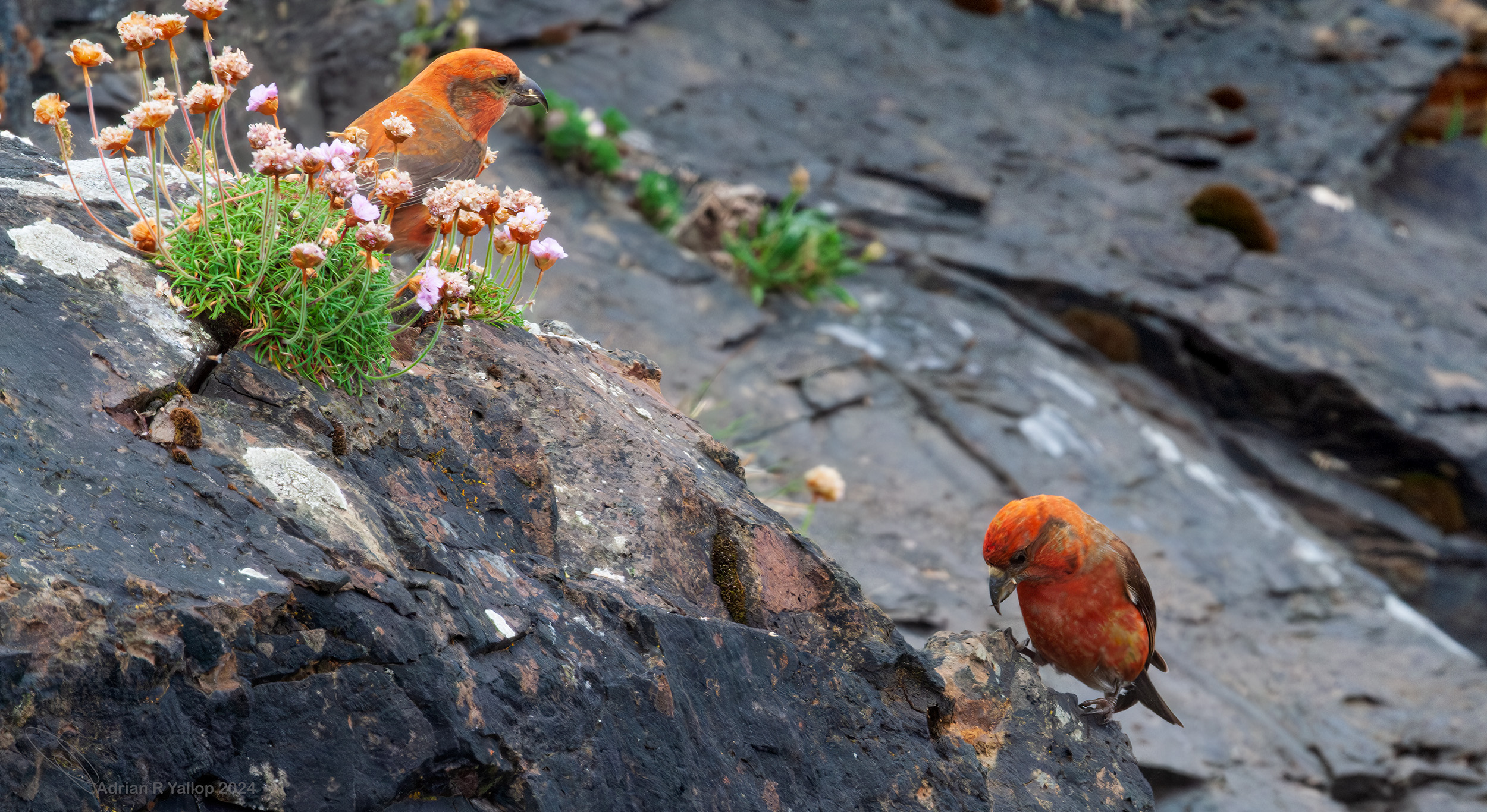
Loxia curvirostra ♂ Eshaness Shetland
05-07-2009
Canon 350D EF 100-400mm (400mm) f16.0 1/250th ISO 1600
if we could overhear the conversation
I don't know what this chap is saying but it has to include ".... this is totally ....", probably followed by "... and this is absolutely the .......last time I follow you anywhere"

Loxia curvirostra ♂ Eshaness Shetland
05-07-2009
Canon 350D EF 100-400mm (400mm) f9.0 1/800th ISO 1600
poor image quality
I should apologise for the poor quality of these, but they're taken with a Canon 350D - urrgh. and it was raining, and windy, and I was wet, and getting cold, is that enough?
As I said I hope to improve my offering of Crossbills in the future. One day. Oh, waiting on the doorstep the next morning was a poor dead male Crossbill, I imagine he must have collided with an upstairs window. He was beautiul of course, he was buried before the cat ate him.

Loxia curvirostra ♂ Eshaness Shetland
08-04-2024
Canon 350D EF 100-400mm (400mm) f5.6 1/800th ISO 400
Yellowhammer Emberiza citrinella
Now, interestingly, well to me at least, the current name ‘yellowhammer’ derives as a corruption of Yellow ammer, the latter being akin to the German word for ‘bunting’ Finding that bit out explained over half a century of mystery to me, although I presume not too much of one considering I clearly never bothered to find out before. Fairly predictably, most earlier regional names derive from its colour, as in: Yellow Amber Yellow Omber (Salop), Yellow Yowley, Yellow Yeldrin and Yellow Yite (both from Scotland). A number of other colour-orientated names like Yeldrock, Yeling, Yowley, Yolling, Gladdie (from gladde=bright: Devon, Cronwall), Blakeling (Northumberland) and Bessie-Blakelin (Westmorland). The Gaelic name Buidheag-Bhearaidh means yellow broom.
Of course many names, mostly cheerful, result from its call, we have the well known Little-bread-no-cheese (Devon) and variants such as Bread and Cheese (Salop) and the ‘Little bit a’ bread but no cheese I learned in Norfolk. Now, from Gloucestershire we get Pretty Pretty Creature and, yup, from those cheerful folk in Scotland we have, I kid you not, the truly delightful De’il, de’il, de’il tak’ you. I mean seriously guys how bitter does one have to be to hear a Yellowhammer singing and think of the devil taking you. I don’t know. Maybe it’s all that running through Gorse bushes in a skirt with nothing underneath that creates all this angst.
Actually, no I’m wrong. It has nowt to do with thorn-shredded testes. This latter bit of misery relates to Scottish folklore. According to Robert Chambers (Popular Rhymes of Scotland, 1870) the Yellowhammer is called the ‘Devil’s Bird in the north of Scotland and is the subject of an unaccountable superstition amongst the peasantry that it drinks a drop of blood of the Devil every morning in May, although some thought 3 drops and some said only on Monday mornings. Apparently, Scotch children, had a rhyme:
"Half a paddock, half a toad,
Half a yellow yorling
Drinks a drap o' the de'il's bluid
Every May morning."
He goes on to relate that these lovely Scotch children hang all the yellow ammers they can get by the neck. They often take the bare “gorbals" (unfIedged young), and suspend them by a thread tied round the neck to one end of a crossbeam, which has a small stone hung from the other. They then suddenly strike down the stone end and drive the poor bird into the air. This operation they call "spangie-hewit." "Hewit," seems derived from the old Anglo-Saxon heafod the head. "Spang" is to fly off with elasticity; to make the head spring or fly off.
I think we’ll stop there, before I’m sick. What a delightful species we are. Oh, before I do, let me relate a note from Thomas Bewich (1826) '.. this bird is common in every hedge or lane'. Well they aint any more, yet another triumph for MAFF and British agricultural polices that actually paid farmers (using your money) to destroy hedgerows.
mellow yellow
....... at last we get a few words from him, something about not having all the ingredients for a cheese sandwich
right now I probably have only a few minutes before droves of armed Police arrive in response to hysterical calls from dog-walkers about camouflage terrorists lurking in bushes directly under the approach path to Inverness airport. No doubt by now I'm armed with a manpad missile, or a bazooka, not a Canon 500mm
I wonder whether the knowledge it would take them days to polish all the dogshit off their shiny boots would be enough compensation for being shot, probably not, but it might puzzle them why I had a smile on my dead face tho'. Nah, they'd think it was all that heavenly virgins thing.

Emberiza citrinella ♀ Carse of Delneys
09-04-2025
Canon R5 EF500mm f4 1/2899th ISO 250
mellow yellow
...... another Ahab moment. For me this is another white whale species, ie present where I live but I never get a pretty picture, despite trying. In this case mostly because you hear one, you can see it a fair distance away, but the moment you try to approach close enough the little buggers they fly off to another bush 50-100m away, repeat till you get bored.
But I have set myself the challenge of harpooning (metaphorically, no matter how much they annoy) as many of these white whales as I can this year. So, nice sunny day, off to a big area of coastal gorse, see some, try and get close and, yup away they go! Sooo, 5 hours later, I go home! How many picture you ask, nil, nada, zilch. Still I had a nice day, I even got a paddle, looking like a blue-footed booby in moments. Oh, and it's surpising how different dog-walkers react when a camouflaged man creeps round a gorse bush in front of them! I must write a book on it sometime. Of course the dog knows because they've run ahead, stopped for a pat, and carried on. If, they do return to their unsuspecting, soon to be terrfied, owner I suspect they keep it to themselves so they can have larf.
Next day, sunny. Go back and try a different strategy, instead of sneaking around in the bushes like a pervert, I decide to sit like one between them near where I saw one or two yesterday. Ditto dog-walkers, only slightly more so. Well this turns out to be the way to go, if you've got all day. Oh, bring a cold drink, I didn't.
After a cumulative 8 hours over two days I get a break, and one perches nearby, for a whole minute nearly. I hit the button, I have at least a shot or so, I wait for him to sing.......

Emberiza citrinella ♀ Carse of Delneys
09-04-2025
Canon R5 EF500mm f4 1/2899th ISO 320
Reed Bunting Emberiza schoeniclus
I’m not a great lover of moustaches, I grew one once, when very young and foolish, and I’ve seen the pictures. The male Reed Bunting carries one off with far far more style.
It’s habit gives us a couple of older names, viz. Reed Sparrow (Notts) and Water Sparrow (Salop), corresponding respectively to the French Moineau des joncs and Moineau d'eau . Its colouration, well that of the male, lying behind many more with the bright white collar giving Ring Bird, Ring Bunting and Ring Fowl (Aberdeen). The males obvious black head gave Black-headed Bunting, Black Bonnet, Coaly Head (Scotland) Black Coaly-Hood (South Scotland), Colin Blackbeard (Renfrew: and my favourite) Black Cap (Craven, Hants). The female got her own name of Spear Sparrow (Hants). A couple of non-plumage derived names were Chink (Scotland, for its call, not racist) and, finally, Toad Snatcher.
it's the light, i do keep telling you
I’ve been sitting for some time, quite some time, in the hide at Ruthven, seeing what’s to be seen. Nuffin, that’s what. When I arrived here some hours ago I had been greeted cheerfully with what seems to be the phrase I normally receive upon getting to a new hide, “You should have been here **** ago” (*** insert any time period you desire here from a couple of minutes to a day or so, it varies). I returned my usual warm smile, with a silent ‘F... off’ threatening to become audible. Apparently, I had missed an Osprey. Well scooby doo. I unburdened myself from the straps, rucsac and camera, and sat. Bird free vistas in all directions.
After a while the others leave, off no doubt to experience further rare birding delights, leaving me to a pleasant solitude. Then I remember I had added a flask, coffee bags and a little chocolate to the rucsac. I make a cup, sip it, nibble a bit and the day seems sunnier. I could wait happily now for a long time. And I do.
After a good hour or more, as I watch a pair of little grebes loving each other, I make another cup. Then, while finishing the chocolate, I see a female reed bunting flitting about from bush to small tree, and back again. She doesn't really look nice enough (not her, the locale), anyway she's normally hidden deep amongst twigs and branches. There is however, one small sunlit tree, with bare branches, and behind it dark deeply shadowed water. Yeah, why don't you fly over there for a change you bugger, I think. She does !! And sits exposed fully, for a moment or two. Cue shutter. I thank her profusely. Her is her picture, it's pretty enough for me, if it isn't for you, go get your own.

Emberiza schoeniclus ♀ Loch Ruthven
18-03-2026
Canon R5 EF500mm x1.4 f5.6 1/1025th ISO 640
do you see what i mean about the light now
Well, I’m back a few weeks later, same hide, nearly same time. Coffee’s gone, and I’d forgotten the choccy. And it’s a gloomy windy day.
I’m about to give up and walk the 3 miles back home when movement in the corner of my eye reawakens my lapsed attention. And there, in the same small tree, almost the same few twigs I had watched the lovely sunlit female reed warbler above I see a male perched. Well, the light is totaaly poor this time, and he doesn’t make anywhere near as pretty a picture as his missus had a month ago. I’ll replace it when he sits nicely in the sun, but I suspect he’s going to be rather too busy soon feeding screaming mouths to find time to pose for a picture.
So you see what I mean about the light, and how important it to keep revisiting places at different times, if you can, to help you find it?

Emberiza schoeniclus ♂ Loch Ruthven
10-04-2026
Canon R5 EF500mm x1.4 f5.6 1/1025th ISO 640
